

How to Choose the Right Salah Time Indicator for Your Masjid
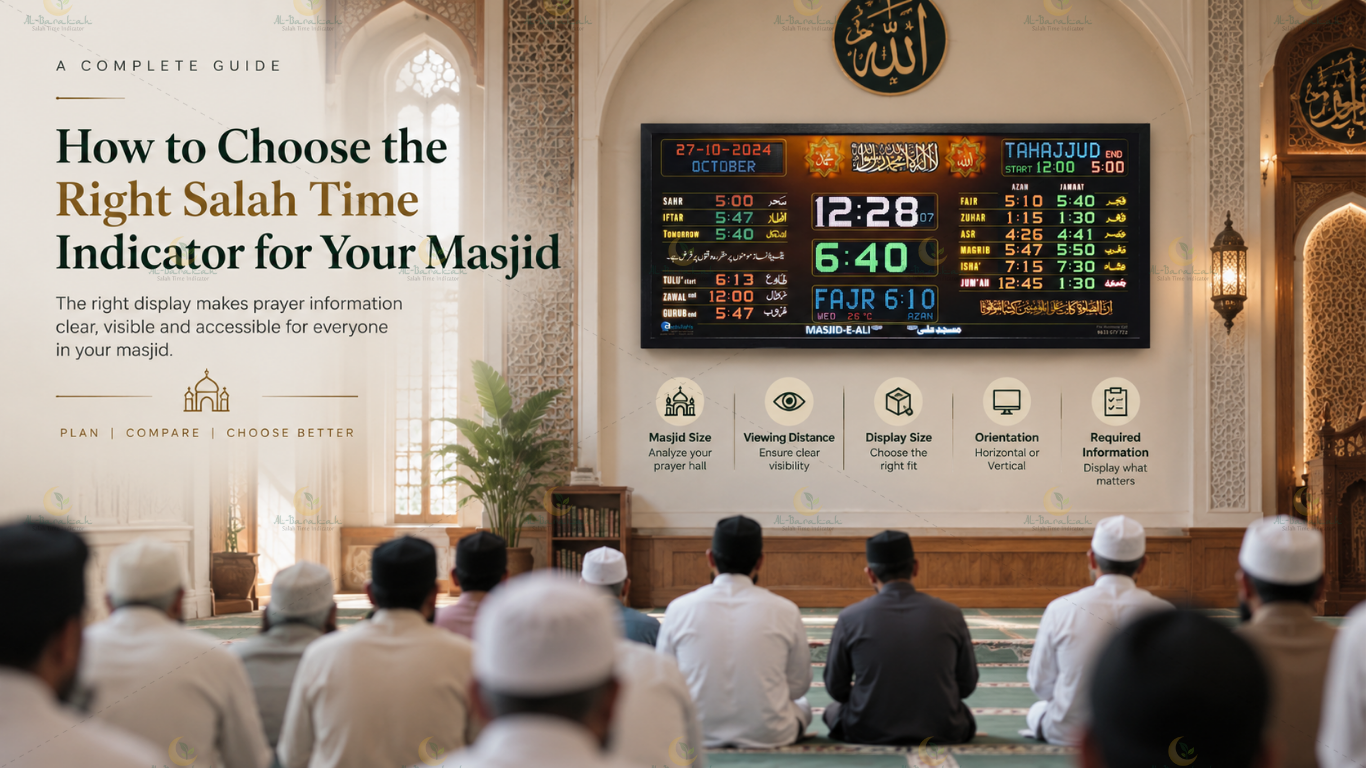
Choosing a Salah Time Indicator for a masjid is more than selecting a digital display that looks good on the wall. The right system should be easy to read, appropriate for the size of the prayer hall, suitable for the masjid’s prayer schedule, and practical for everyday use.
Masjids vary significantly in size and layout. A compact prayer space may need a smaller display, while a large masjid may require a much larger Salah Time Indicator that can be clearly seen from the back of the prayer hall. The information required can also differ—from basic Salah and Jama’at timings to additional information such as the next Jama’at, Makrooh timings, dates, and scrolling announcements.
This guide explains the key factors to consider before buying a Salah Time Indicator, so your masjid committee can make an informed decision based on actual requirements rather than simply choosing the largest or most expensive model.
1. Start With the Size of Your Masjid
The first consideration should be the physical environment where the Salah Time Indicator will be installed.
A display that is suitable for a small masjid may not be appropriate for a large prayer hall. The further worshippers are from the display, the more important display size and digit visibility become.
Before choosing a model, consider:
- Size of the prayer hall
- Approximate viewing distance
- Available wall width and height
- Number of worshippers
- Pillars or architectural obstructions
- Lighting conditions
- Intended mounting location
The objective is simple:
People should be able to read the important information without having to move closer to the display.
For a small masjid or musalla, a compact Salah Time Indicator may be sufficient. For a larger prayer hall, a larger-format display with appropriately sized digits can provide better visibility.
2. Consider the Viewing Distance
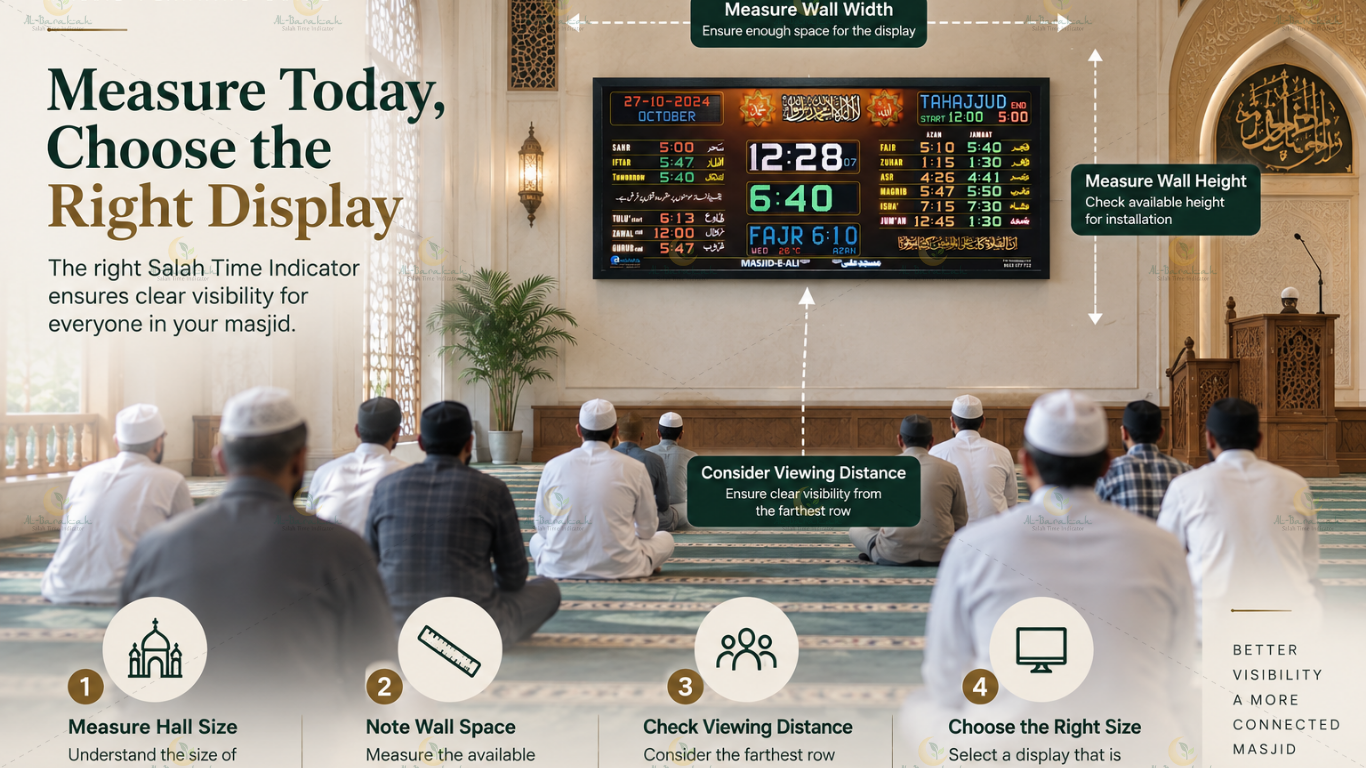
Viewing distance is one of the most important factors when selecting a digital Salah Time Display.
A display may look perfectly clear when viewed from a few metres away but become difficult to read from the back of a large prayer hall.
Think about the furthest point from which worshippers will normally need to read the display.
For example:
Small prayer hall → shorter viewing distance → compact display may be suitable
Large prayer hall → longer viewing distance → larger display may be more appropriate
This does not mean that the biggest available display is always the best choice. The display should be appropriately sized for the space and the information being shown.
When discussing your requirements with a supplier, providing the approximate viewing distance can help them recommend a more suitable model.
3. Decide What Information Your Masjid Needs
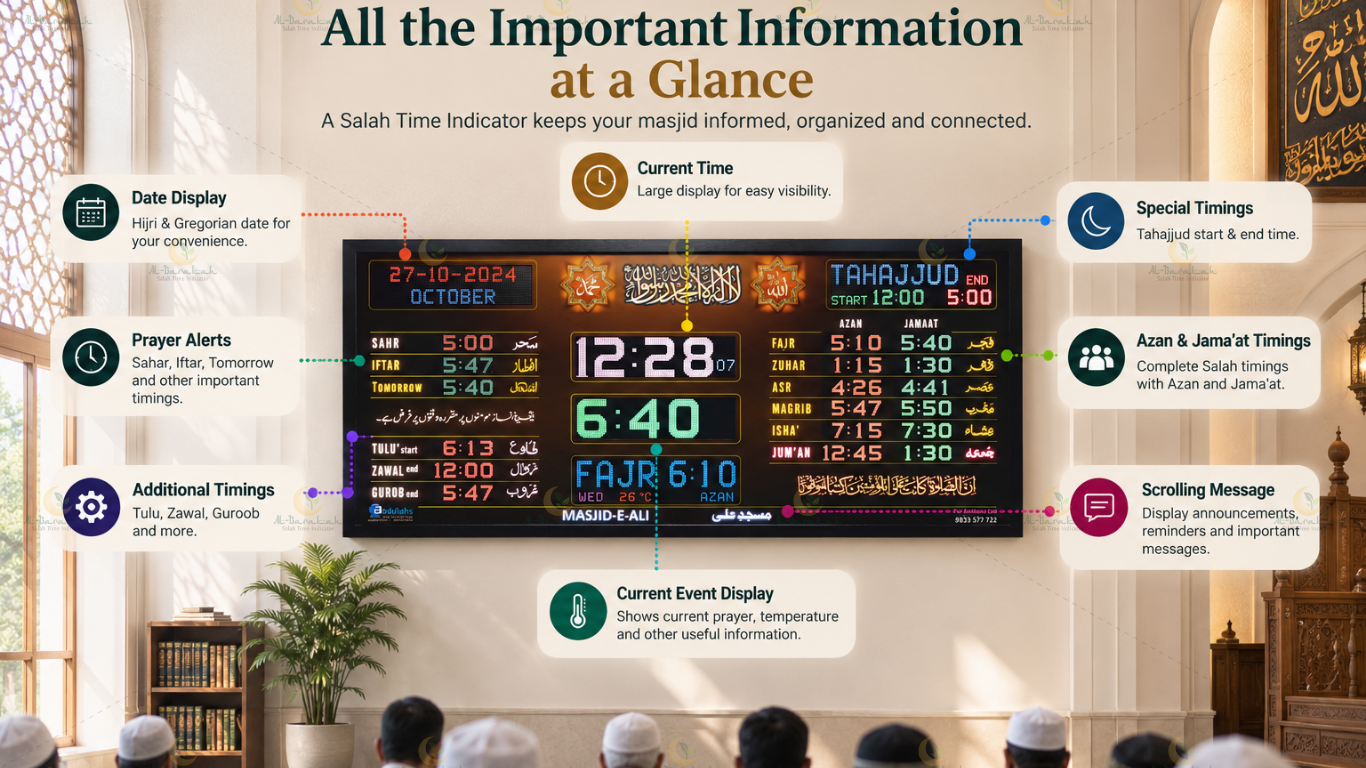
Not every masjid requires the same amount of information.
Before comparing products, make a simple list of what you want the display to show.
A Salah Time Indicator may provide information such as:
- Current time
- Fajr timing
- Dhuhr/Zuhr timing
- Asr timing
- Maghrib timing
- Isha timing
- Azan timings
- Jama’at timings
- Next Jama’at
- Makrooh-related timings
- Hijri date
- Gregorian date
- Special events or reminders
- Scrolling messages
The exact features depend on the model.
A useful approach is to separate the requirements into two categories:
Essential information
Vertical Salah Time Display
This prevents the committee from paying for features that aren’t actually needed while ensuring important information isn’t left out.
4. Understand the Difference Between Salah Time and Jama’at Time
This distinction is particularly important when choosing a Masjid Prayer Time Display.
The prayer timetable and the masjid’s Jama’at schedule serve different purposes.
A prayer time indicates the relevant time associated with the prayer schedule being followed, while the Jama’at time tells worshippers when the congregation is scheduled to begin at that particular masjid.
For example, the masjid may display:
Fajr — Azan: 5:40 | Jama’at: 6:10
This immediately communicates both pieces of information.
For a masjid, having both timings visible can be considerably more useful than having only a general prayer timetable.
5. Choose Between Horizontal and Vertical Displays
Salah Time Indicators are available in different physical orientations.
The two common options are:
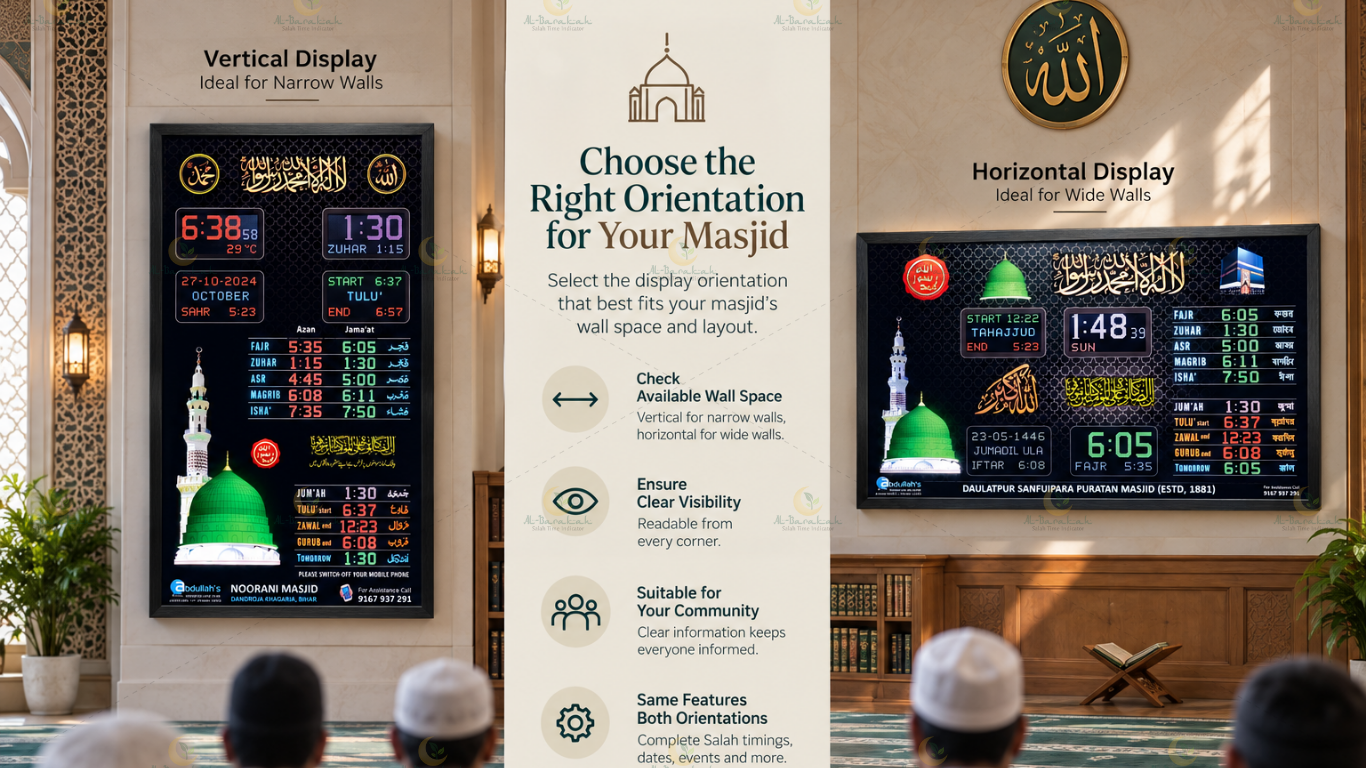
Horizontal Salah Time Display
Vertical Salah Time Display
6. Think About Display Readability
A digital prayer display is only useful if people can read it comfortably.
When evaluating a display, consider:
- Digit height
- Text size
- Viewing distance
- Contrast
- Brightness
- Viewing angle
- Ambient lighting
A masjid with strong natural light may have different requirements from a darker indoor prayer hall.
It is also important to consider the information hierarchy. The most important information—such as current time and upcoming prayer or Jama’at information—should be easy to identify at a glance.
Good visibility is more important than simply having more information on the screen.
7. Consider How the Salah Timings Will Be Managed
Prayer timings change throughout the year, so the system should be practical for the masjid committee to manage.
Before purchasing, ask how the display is configured and updated.
Questions worth asking include:
- How are prayer timings entered?
- How are Jama’at timings updated?
- Can timings be adjusted when the masjid changes its schedule?
- How are seasonal changes handled?
- Can the system be configured for the local timetable?
- Who can make changes?
- Is setup assistance available?
The important point is that the display should follow the prayer timetable adopted by the masjid and its local religious guidance. A digital display is a communication tool; the underlying timetable should come from the appropriate authority or established masjid schedule.
8. Choose the Right Display Size, Not Simply the Biggest One
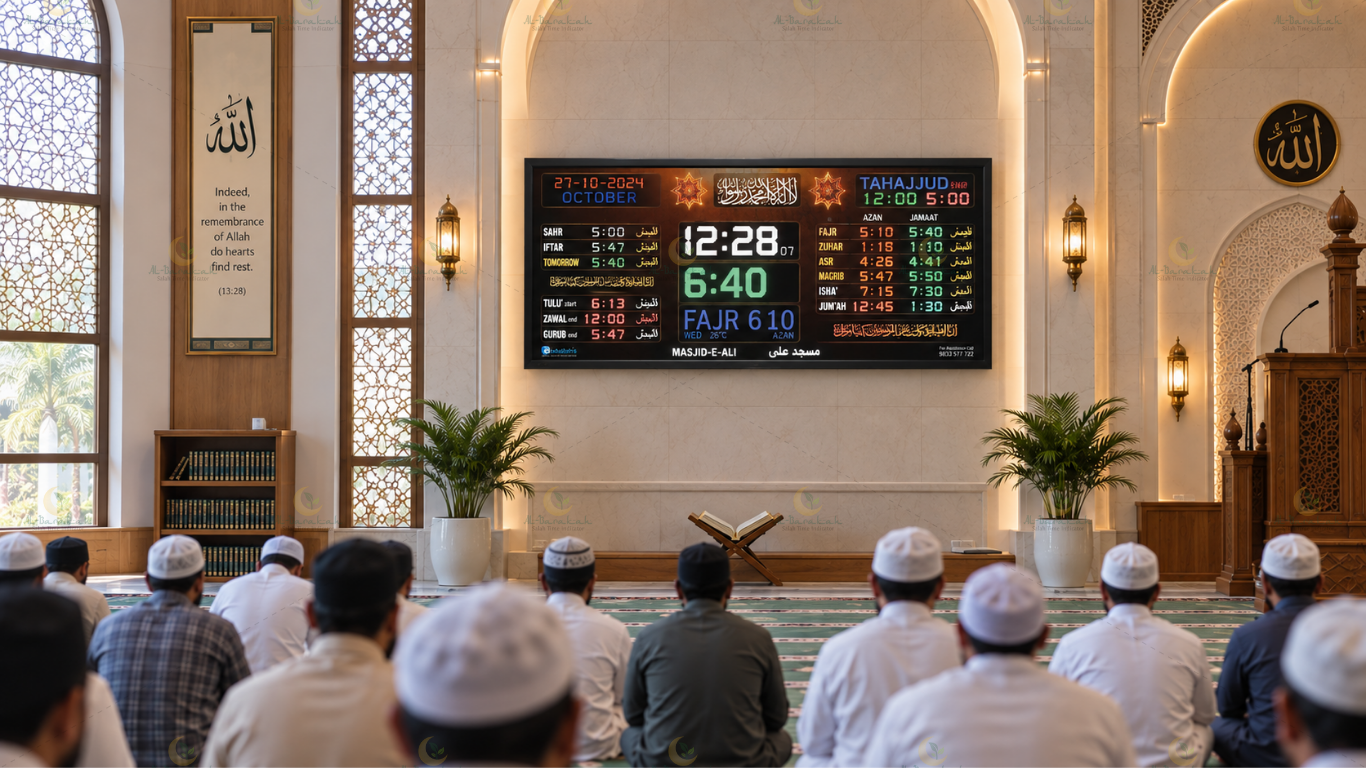
Bigger does not automatically mean better.
A display that is unnecessarily large can consume valuable wall space and may not suit the architecture of the masjid.
On the other hand, choosing a display that is too small can compromise readability.
The ideal size depends on:
Viewing distance + available wall space + information requirements + prayer-hall layout
For example:
| Masjid Environment | Typical Priority |
| Small prayer space | Compact size and essential information |
| Medium prayer hall | Visibility and balanced information |
| Large prayer hall | Larger display and long-distance readability |
| Narrow wall | Vertical orientation |
| Wide wall | Horizontal orientation |
Use this as a starting framework rather than a rigid rule. The actual dimensions and display specifications should be evaluated for each installation.
9. Consider the Installation Location
The best Salah Time Indicator can still be ineffective if it is installed in the wrong place.
Before finalizing the model, identify the proposed installation point.
Check whether the display will be:
- Clearly visible from the prayer area
- Free from pillars or other obstructions
- At a suitable height
- Protected from unnecessary glare
- Close to an appropriate power source
- Accessible for configuration and maintenance
A front wall may seem like the obvious choice, but every masjid has a different architectural layout.
It is better to assess the actual prayer hall before deciding where the display should be mounted.
10. Look at Long-Term Reliability and Support
A Salah Time Indicator is generally a long-term masjid installation, so the buying decision should go beyond the initial purchase price.
Consider the supplier’s:
- Product experience
- Technical support
- Installation guidance
- Warranty
- Service support
- Availability of assistance after installation
This is particularly relevant for masjids because the person responsible for operating the display today may not be the same person managing it several years later.
A system that is supported by clear documentation and responsive technical assistance can be easier for future committee members to manage.
11. Don't Choose a Salah Time Indicator Based Only on Price
Price is naturally an important consideration for a masjid committee, but it should be evaluated alongside the total value of the system.
a better question is:
Two displays may look similar in photographs but have different display sizes, information layouts, functionality, configuration options, or support arrangements.
A lower upfront price is not necessarily better value if the display is too small for the prayer hall or lacks an important feature the masjid needs.
12. Ask These Questions Before Buying
Before placing an order, the masjid committee can use this checklist.
Prayer Hall
- How large is the prayer hall?
- What is the maximum viewing distance?
- Where will the display be installed?
- Are there pillars or other obstructions?
Display
- What size display is appropriate?
- Are the digits large enough?
- Would horizontal or vertical orientation work better?
- Is the display easy to read in the available lighting?
Information
- Do we need Azan timings?
- Do we need Jama’at timings?
- Do we need Next Jama’at?
- Do we need additional timing information?
- Do we need Hijri and Gregorian dates?
- Do we need scrolling messages or announcements?
Management
- How are timings updated?
- Can the masjid adjust Jama’at timings?
- How easy is the system to operate?
- What happens if the responsible committee member changes?
Support
- Is installation guidance available?
- What warranty is provided?
- Is after-sales support available?
- Who should the masjid contact if assistance is required?
Having answers to these questions will make it much easier to compare different Salah Time Indicator models.
What Is the Best Salah Time Indicator for a Masjid?
There is no single model that is best for every masjid.
The best Salah Time Indicator is the one that matches the masjid’s physical space, viewing distance, information requirements, installation conditions and budget.
A small masjid may benefit from a compact display focused on essential information.
A larger masjid may require a larger-format display with greater visibility and more information.
A masjid with limited wall width may find a vertical model more practical, while a wide prayer hall may benefit from a horizontal layout.
The key is to select based on requirements first and product features second.
Final Checklist for Choosing a Salah Time Indicator
Before making the final decision, make sure you have considered:
-
Prayer hall size
-
Maximum viewing distance
-
Available wall space
-
Horizontal or vertical orientation
-
Digit and text visibility
-
Salah and Azan timings
-
Jama’at timings
-
Next Jama’at requirements
-
Additional timing information
-
Hijri and Gregorian dates
-
Announcement or scrolling requirements
-
Ease of configuration
-
Installation requirements
-
Warranty and after-sales support
-
Overall value—not just purchase price
Once these factors are clear, comparing Salah Time Indicators becomes much easier.
Choose a Salah Time Indicator Based on Your Masjid's Needs
A Salah Time Indicator should make prayer information clearer, easier to access and more useful for the people attending the masjid.
The right choice isn’t necessarily the largest display, the most feature-rich model, or the lowest-priced option. It is the system that provides the right information at the right size and remains practical for the masjid to operate over time.
At Al-Barakah, our Salah Time Indicator range is designed for different masjid requirements, from more compact prayer spaces to larger installations. When evaluating a display, consider your prayer hall dimensions, viewing distance, wall space and required information first.
If you’re unsure which size or format is suitable, sharing these details with an experienced supplier can help narrow down the appropriate options.
Planning to install or upgrade a Salah Time Indicator in your masjid? Start by measuring your available wall space and maximum viewing distance, then compare displays based on the information your worshippers actually need.
Frequently Asked Questions About Azan Clock
How do I choose the right Salah Time Indicator for my masjid?
Start by considering the prayer hall size, maximum viewing distance, available wall space, required prayer and Jama’at information, display orientation, installation requirements and budget. These factors will help determine the most suitable display.
What size Salah Time Indicator do I need?
The appropriate size depends primarily on viewing distance and the size of the installation area. Larger prayer halls generally require displays that remain clearly readable from greater distances.
Should I choose a horizontal or vertical Salah Time Indicator?
Choose based on the available wall space and layout of your masjid. Horizontal displays can suit wide walls, while vertical displays can be useful where wall width is limited.
What information should a masjid prayer display show?
Common requirements include current time, Salah or Azan timings and Jama’at timings. Depending on the masjid, additional information such as Next Jama’at, dates, Makrooh-related timings and announcements may also be useful.
Is a larger Salah Time Indicator always better?
No. The display should be appropriately sized for the prayer hall and viewing distance. An unnecessarily large display may waste wall space, while an undersized display may be difficult to read.
Why is viewing distance important?
Viewing distance determines how easily worshippers can read the display from different parts of the prayer hall. A display suitable for a small room may not provide sufficient visibility in a large masjid.
Should price be the main factor when buying a Salah Time Indicator?
Price is important, but it should be considered alongside display size, visibility, required features, reliability, configuration and after-sales support. The best value is the solution that meets the masjid’s actual requirements.
Can Jama’at timings be different from Salah timings?
Yes. The prayer timetable and the Jama’at schedule serve different purposes. A masjid may schedule its congregation at a particular time after the relevant prayer time begins.